The World of Nanban Byōbu: Art, Architecture, and Cultural Encounters (c. 1543–1639)
The screen was produced during the height of the Namban Trade Period (南蛮貿易時代), when Portuguese merchants and Jesuit missionaries regularly travelled between Macau, Goa, Malacca, Nagasaki, and other ports in East Asia. Unlike many later Namban screens that became increasingly decorative, Naizen’s work appears to be based on direct observation of Portuguese visitors and Christian communities in Japan. It combines commercial, religious, and social themes into a single visual narrative.
1. Nanban Byōbu (南蛮屏風)
Osaka Castle Museum (大阪城天守閣)
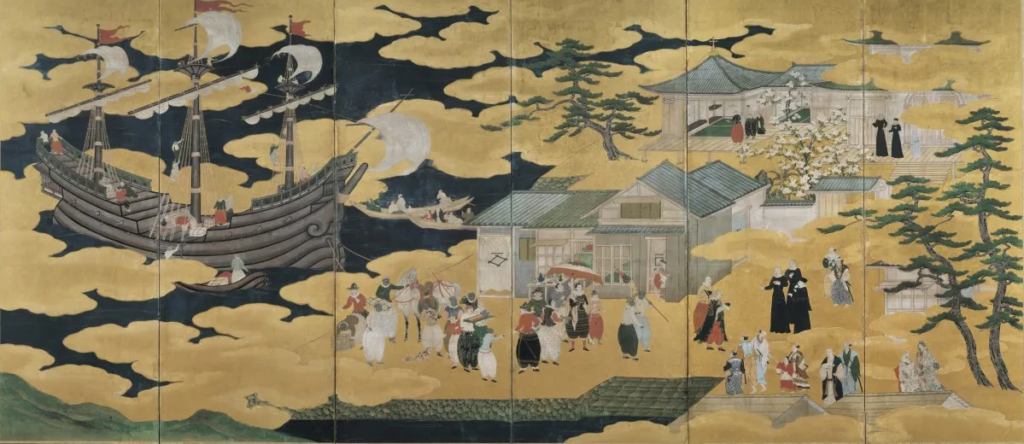
Catalogue Information
Title: Nanban Byōbu (南蛮屏風, Folding Screen Depicting Southern Barbarians)
Collection: Osaka Castle Museum (大阪城天守閣)
Designation: Important Cultural Property (重要文化財)
Date: Early Seventeenth Century (Edo Period)
Genre: Nanban Art (南蛮美術)
The author would like to express his sincere gratitude to the Osaka Castle Museum for granting permission to reproduce this image as part of this research project. For further information about the museum and its collections, please visit the official website via the link below.
本研究プロジェクトにおける本画像の掲載をご許可いただきました大阪城天守閣に、心より御礼申し上げます。同館およびその所蔵品に関する詳細については、以下の公式ウェブサイトをご覧ください。
Unauthorized reproduction, copying, or downloading is prohibited.
無断転載・複製・ダウンロードを禁じます。
We shall now analyze the individual elements depicted in the image. First, we will examine those related to the city and its exterior spaces, proceeding from left to right.
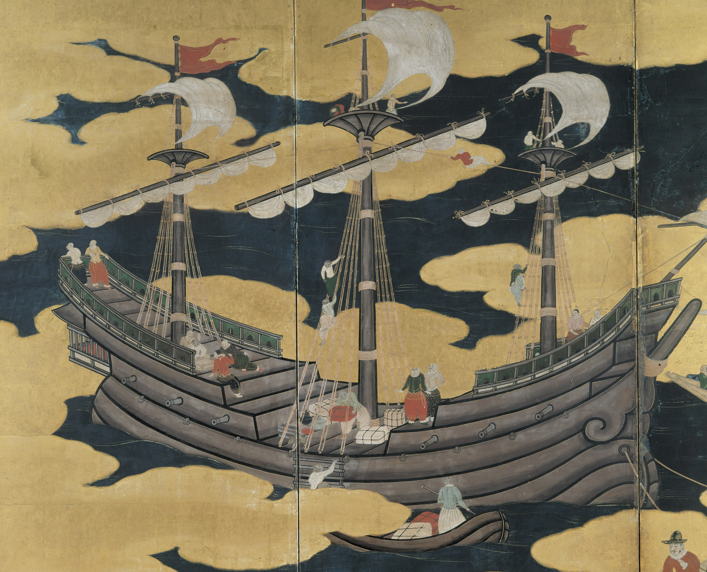
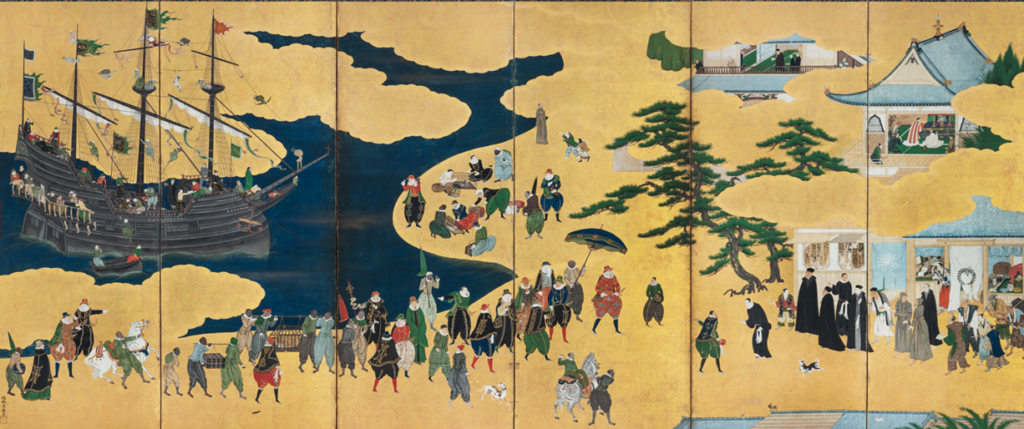
The large vessel dominating the composition is one of the most visually striking elements of the Nanban folding screen. More than a background motif, it occupies a central place in the visual narrative of Portuguese arrival and evokes the maritime networks that connected Japan with the wider world during the late sixteenth and early seventeenth centuries. Its enormous dark hull, high sides, multiple decks, towering masts, extensive rigging, and large sails distinguish it sharply from the smaller Japanese craft represented nearby.
Portuguese vessels of this kind came to be known in Japan as kurofune (黒船, “black ships”), a term associated with the dark appearance of their hulls. Contemporary Japanese observers regarded these great ocean-going vessels with considerable curiosity, and they subsequently became one of the most recognizable motifs of Nanban painting. The precise origin of the term is not entirely certain, although it was probably related to the dark or blackened appearance of the hull. In the folding screens, this visual characteristic is further emphasized by the monumental scale of the vessel, reinforcing the idea that the arrival of the Portuguese was, above all, a maritime event. Merchants, missionaries, sailors, servants, commodities, animals, and information all reached Japan through these maritime connections.
The vessel should not, however, be understood simply as a ship sailing directly from Portugal to Japan. It formed part of the much broader maritime system of the Portuguese Estado da Índia, which connected Europe, Africa, India, Southeast Asia, China, and Japan. Within the context of the Japan trade, the crucial connection was the route between Macau and Nagasaki. Portuguese merchants operating from Macau transported Chinese silk and other commodities to the Japanese market, while Nagasaki developed into one of the principal points of contact between Portuguese maritime commerce and Japan. The ship depicted in the screen therefore embodied a geographical network extending far beyond the Japanese archipelago and even beyond the direct relationship between Portugal and Japan.
The numerous flags and banners attached to the masts and rigging further emphasize the foreign identity and ceremonial presence of the vessel. The painter’s purpose was not necessarily to provide a technically precise record of European naval architecture. Rather, particular features appear to have been selected and visually amplified to communicate the extraordinary character of the ship to a Japanese audience: its immense dark hull, high sides, multiple masts, complex rigging, large sails, anchors, flags, and densely populated decks. In this sense, the ship functions simultaneously as a representation of a real maritime technology and as an artistic construction of foreignness.
Particularly significant is the contrast between the enormous Portuguese vessel and the much smaller boats surrounding it. These smaller craft establish the physical connection between the ocean-going ship and the Japanese shore, facilitating the movement of passengers, merchandise, and supplies. In the visual narrative of the Nanban screens, the sequence from ship to boat and from boat to land transforms maritime commerce into a carefully structured process of arrival. The large vessel thus becomes a floating transitional space between distant maritime regions and the Japanese urban environment depicted elsewhere in the composition.
The numerous figures visible on its decks reinforce this interpretation. The ship is not represented as an empty technological object but as a densely inhabited and socially complex environment. Sailors, merchants, servants, and other travellers occupy different parts of the vessel and participate in the process of arrival. Historically, moreover, the crews and passengers aboard Portuguese ships operating in Asian waters were themselves remarkably diverse. The maritime world connecting Macau and Japan brought together Europeans, Asians, Africans, and people of mixed backgrounds, making the ship not only a vehicle of transportation but also a mobile space of cross-cultural encounter.
For a Japanese viewer of the Momoyama and early Edo periods, such a vessel could therefore signify much more than European naval technology. It evoked long-distance travel, distant lands, commercial wealth, exotic commodities, and geographical worlds extending far beyond Japan. The extraordinary scale assigned to the ship in Nanban painting reflects precisely this broader symbolic importance. The kurofune was simultaneously a means of transportation, an infrastructure of commerce, and a powerful visual manifestation of the maritime networks that brought the Nanbanjin to Japan.
By placing the vessel prominently within the composition and surrounding it with smaller boats, passengers, cargo, flags, and maritime activity, the painter transformed the Portuguese ship into a visual expression of encounter itself. It was the material mechanism through which people and commodities moved, but also through which religions, technologies, artistic objects, information, and knowledge circulated between Japan and the wider early modern world.
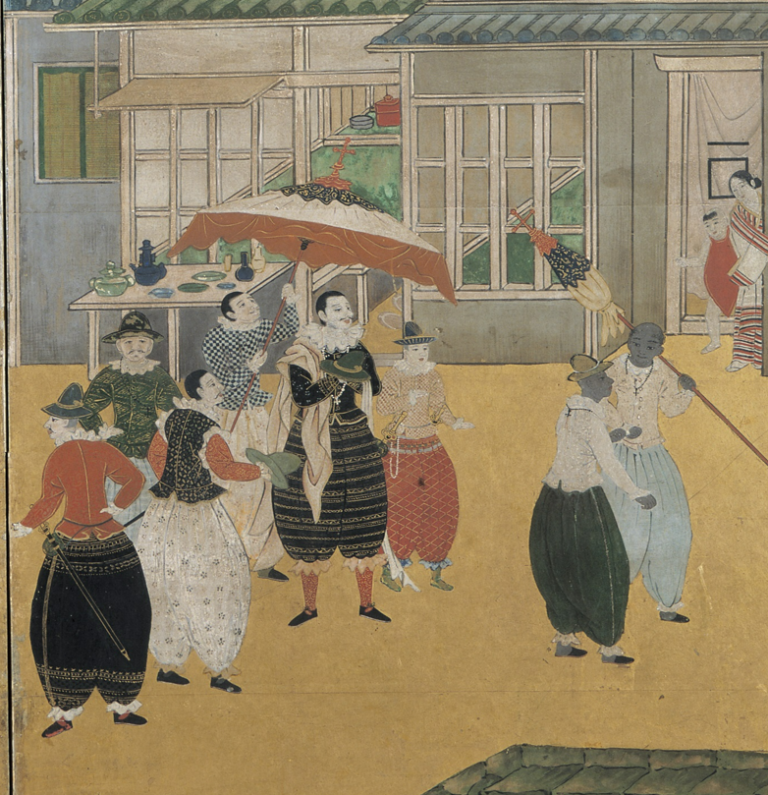
Among the most significant figures represented in the Nanban byōbu are the dark-skinned attendants accompanying the Portuguese procession. In this scene, they perform different roles within the entourage: some carry objects and baggage, while others accompany the procession alongside merchants, missionaries, animals, and other attendants. Their darker skin, distinctive clothing, and physical appearance clearly distinguish them from the Portuguese figures elsewhere in the composition, making them one of the most visually recognizable elements associated with the Nanbanjin.
These figures have generally been interpreted as Africans connected to the Portuguese maritime world. Africans were present throughout the Portuguese Estado da Índia by the late sixteenth century, including servants, sailors, soldiers, freedmen, personal attendants, and enslaved people. They moved through networks linking Africa and the Indian Ocean with Goa, Malacca, Macau, and ultimately Japan. Their appearance in the Nanban screens therefore provides important visual evidence that the encounter between Japan and the Portuguese was never simply a bilateral encounter between Europeans and Japanese. It was part of a much broader maritime world that also included Africans, Indians, Chinese, Malays, Japanese converts, and other communities moving through Portuguese-controlled and connected ports.
At the same time, the precise identity and legal status of individual figures cannot be established from the paintings alone. Although their physical appearance strongly suggests African origins, visual characteristics such as skin colour do not by themselves identify a specific geographical background or social condition. Historical evidence demonstrates that Africans in Portuguese Asia occupied a variety of positions. Some were enslaved, while others were freedmen, sailors, soldiers, or personal attendants. A significant proportion of Africans attached to Portuguese households were nevertheless enslaved, and Portuguese maritime expansion was closely connected to extensive systems of slavery linking Africa, India, Southeast Asia, and East Asia.
This distinction is particularly important when interpreting the Nanban byōbu. The paintings should not be treated as literal records from which the status of every individual can be reconstructed. Rather, they should be read in conjunction with documentary evidence about the social composition of the Portuguese maritime world. The figures represented carrying goods or accompanying Portuguese officials may have occupied different legal and social positions, even when the painter presents them collectively as members of the foreign entourage.
Their prominent inclusion nonetheless reveals something significant about the Japanese perception of the Portuguese presence. Japanese painters repeatedly emphasized the dark skin, distinctive clothing, and physical appearance of African figures. Rather than rendering them as incidental background characters, they frequently made them highly visible within the composition. Alongside Europeans, exotic animals, imported goods, and unfamiliar clothing, these figures contributed to a visual image of the extraordinary geographical reach of the Portuguese maritime networks.
The relationship between these attendants and the wider procession is therefore particularly important. The composition brings together Europeans, Africans, foreign commodities, exotic animals, missionaries, and merchants within a single narrative space. For Japanese viewers, this diversity could suggest that the Portuguese came from a vast and unfamiliar world extending far beyond the geographical horizons of Japan itself. The African figures thus functioned visually as evidence of connections reaching across Africa, the Indian Ocean, Southeast Asia, China, and Japan.
From a modern historical perspective, however, their presence also introduces a more difficult dimension into the spectacle of the Nanban arrival. The maritime networks represented through magnificent ships, luxury textiles, imported goods, and exotic animals were sustained not only by commerce and voluntary migration but also by unequal forms of labour and, in many cases, enslavement. Portuguese expansion across the Indian Ocean depended upon complex hierarchies of merchants, sailors, soldiers, servants, freed people, and enslaved populations whose movements were shaped by very different degrees of freedom and coercion.
The dark-skinned attendants in the Nanban byōbu should therefore not be understood merely as picturesque symbols of exotic diversity. Their representation preserves traces of the human networks that made Portuguese maritime activity possible, while also reminding us of the profound inequalities embedded within those networks. Their presence complicates the celebratory visual language of ships, luxury goods, foreign clothing, and exotic animals by revealing that early modern global mobility could involve both opportunity and coercion.
In this sense, the Nanban screens provide a particularly valuable perspective on the interconnected character of the early modern world. The Portuguese presence in Japan was produced by networks stretching across Europe, Africa, India, Southeast Asia, China, and Japan, bringing together peoples of remarkably diverse origins. The African figures depicted within these compositions make that geographical complexity visible, while simultaneously drawing attention to the forms of servitude and enslavement that accompanied the expansion of maritime commerce across the Portuguese Empire.
2. Nanbanjin Tōrai-zu Byōbu (南蛮人渡来図屏風)
The Museum of the Imperial Collections, Sannomaru Shozokan (皇居三の丸尚蔵館)
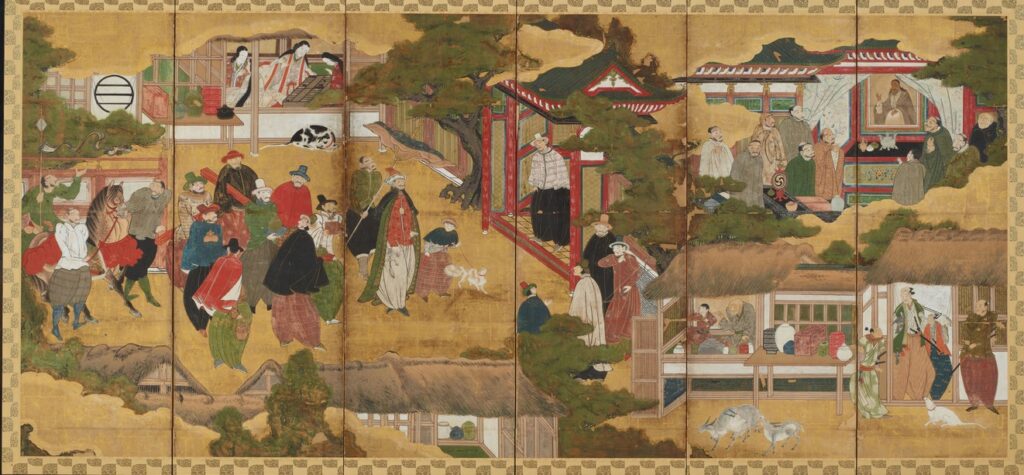
Catalogue Information
Title: Nanbanjin Tōrai-zu Byōbu (南蛮人渡来図屏風, Folding Screen Depicting the Arrival of Southern Barbarians)
Japanese Title: 南蛮人渡来図屏風
Collection: The Museum of the Imperial Collections, Sannomaru Shozokan (皇居三の丸尚蔵館)
Cultural Property Status: Important Cultural Property (重要文化財)
Provenance: Originally preserved at Raigōin Temple (来迎院), Shizuoka; presented to the Imperial Household by Tokugawa Iesato in 1889 (Meiji 22).
The author would like to express his sincere gratitude to the Museum of the Imperial Collections, Sannomaru Shozokan for granting permission to reproduce this image as part of this research project. For further information about the museum and its collections, please visit the official website via the link below.
本研究プロジェクトにおける本画像の掲載をご許可いただきました皇居三の丸尚蔵館に、心より御礼申し上げます。同館およびその所蔵品に関する詳細については、以下の公式ウェブサイトをご覧ください。
Unauthorized reproduction, copying, or downloading is prohibited.
無断転載・複製・ダウンロードを禁じます。
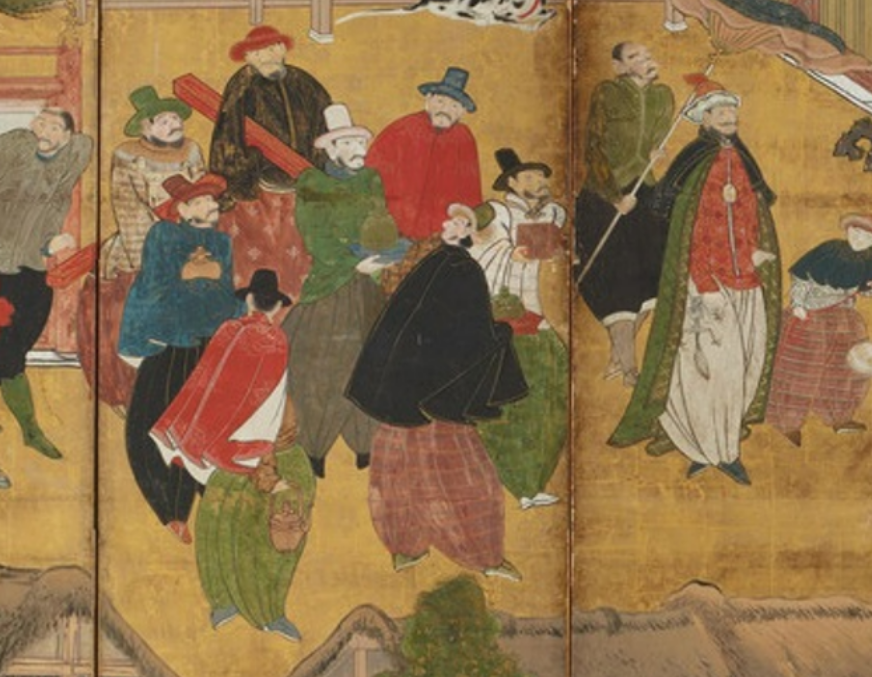
European clothing contrasted sharply with Japanese attire and became one of the most immediately recognizable visual markers of the Portuguese presence in Nanban painting. The figure in the foreground, dressed in a broad black cloak, exemplifies this contrast. Portuguese merchants and other European figures were represented wearing garments markedly different from contemporary Japanese dress, including long cloaks, colourful doublets and jackets, voluminous breeches, hats and caps, ruffs, boots, and other forms of European footwear. Together, these elements created a distinctive silhouette through which the Nanbanjin could be immediately identified.
The contrast between European and Japanese customs was also remarked upon by contemporary Jesuit observers. Alessandro Valignano famously described Japan as extraordinarily different from Europe, an observation reproduced by Michael Cooper in the memorable formulation that “Japan is a world the reverse of Europe.” Within this context, clothing became one of the clearest material expressions of cultural difference. The large black cloaks frequently represented in Nanban byōbu may be associated with the formal attire of wealthy merchants, Portuguese officials, and members of Portuguese administrative and commercial communities in Asia.
Colour played an equally important role. The vivid reds, dark greens, purples, and other rich tones used by Japanese painters contributed to an image of material abundance and social prestige. These garments should also be understood within the broader commercial environment of Portuguese Asia. Portuguese trade depended heavily on the circulation of luxury textiles and other valuable commodities across the Indian Ocean and the South China Sea, including Chinese silks, Indian textiles, velvet, damask, brocade, and embroidered fabrics. The maritime routes connecting Goa, Malacca, Macau, Nagasaki, and other ports enabled such materials to circulate across enormous distances.
The Macau–Nagasaki connection was particularly important within this system. Portuguese merchants operating from Macau transported Chinese silk and other valuable commodities to Japan, making textiles one of the most visible material expressions of the commercial relationship between China, Portuguese Asia, and the Japanese archipelago. The colourful and voluminous garments represented in the screens therefore conveyed more than European fashion alone. They could also evoke the commercial wealth and mobility associated with participation in long-distance maritime exchange.
Particularly distinctive are the exceptionally wide and pleated breeches worn by several Portuguese figures. Their silhouette differed dramatically from contemporary Japanese clothing and became one of the characteristic visual features of the Nanbanjin. João Rodrigues repeatedly drew attention to the curiosity with which Japanese observers regarded European customs and material culture, and in Nanban painting such garments developed into highly recognizable markers of Portuguese identity. Their exaggerated width and volume made the figures visually conspicuous even within the densely populated compositions of the screens.
Headwear performed a similar function. Different forms can be observed, including red hats with short brims, tall black hats, and white caps. In European society, clothing and headwear could communicate distinctions of occupation, status, and social position. Japanese painters appear to have recognized that such differences carried meaning and reproduced variations in hats, cloaks, and other garments when depicting merchants, sailors, missionaries, officials, and other members of the Portuguese entourage. Nevertheless, the precise identity or rank of an individual figure cannot always be established from clothing alone.
Dress could also distinguish religious affiliation. Jesuit missionaries are typically represented in long black cassocks and relatively sober attire, creating a visual contrast with the more colourful clothing of merchants and other secular Portuguese figures. In other Nanban compositions, Franciscans can similarly be distinguished through their grey or brown habits, rope belts, and simpler appearance. Clothing therefore functioned not merely as a marker separating Europeans from Japanese observers, but also as a means of differentiating social and institutional identities within the foreign community itself.
For Japanese viewers of the Momoyama and early Edo periods, Portuguese clothing could consequently signify considerably more than foreignness. Rich fabrics and elaborate garments evoked wealth, access to rare commodities, participation in distant commercial networks, and contact with a wider geographical world. In certain contexts, clothing could also indicate religious or institutional affiliation. These meanings help explain the almost theatrical presentation of Portuguese figures in many Nanban screens, where merchants and officials appear in elaborate processions accompanied by attendants, exotic animals, imported goods, and other visible signs of overseas connections.
This attention to clothing should not, however, be reduced to a simple opposition between a “European” and a “Japanese” world. Portuguese communities in places such as Macau, Goa, and Malacca existed within deeply interconnected and culturally hybrid environments. Many of the textiles, furnishings, and objects associated with Portuguese communities in Asia were produced in China, India, Japan, or Luso-Asian workshops. The material culture represented in the Nanban byōbu therefore reflects not simply goods imported directly from Europe, but the complex circulation of objects and styles across Portuguese Asia.
As Hélène Vu Thanh has emphasized, European encounters with Japan did not take place in a context in which Japan could simply be treated as a colonial periphery. Europeans themselves encountered a politically and culturally sophisticated society whose hierarchies, customs, and expectations had to be carefully negotiated. The detailed representation of Portuguese clothing in the Nanban byōbu can therefore be understood as part of a broader visual negotiation of status and difference. Dress simultaneously marked the Portuguese as culturally foreign and associated them with the prestigious commercial, material, and maritime networks that characterized the Nanban encounter.
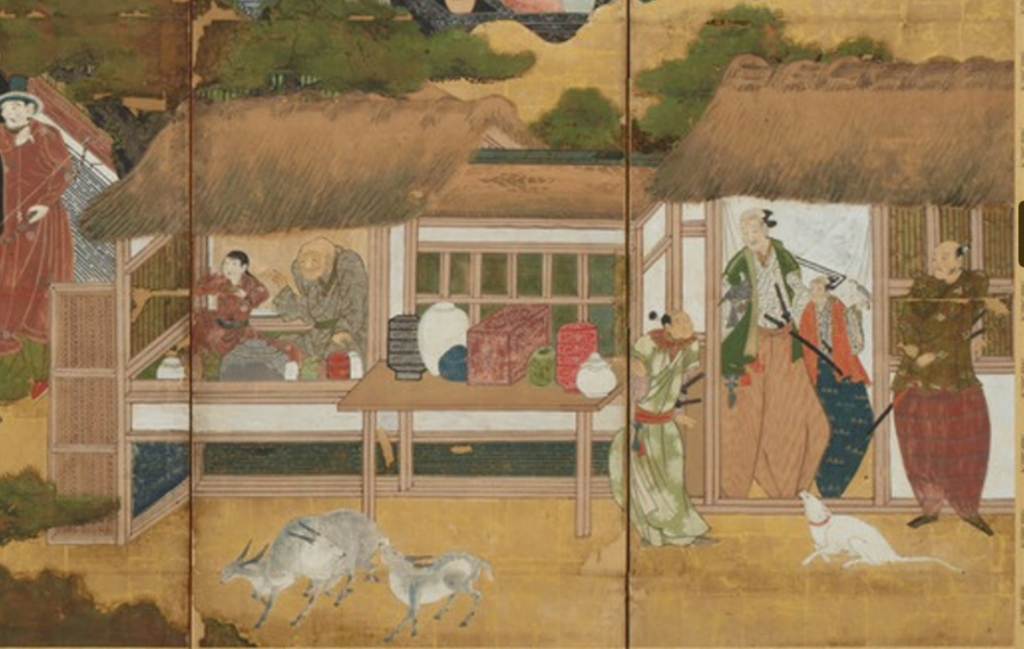
The urban landscape represented in the Nanban byōbu provides important visual evidence for understanding the close relationship between architecture, commerce, and the street in early modern Japanese cities. In this section of the screen, commercial spaces open directly onto the street, keeping goods, merchants, customers, and everyday activities visually connected to public circulation. Rather than presenting buildings as enclosed architectural objects separated from urban life, the painter emphasizes the interaction between interior and exterior. Open façades, curtains, and partially exposed interiors allow the viewer to look directly into shops and observe the activities taking place within them.
This relationship between commercial buildings and the street corresponds closely to contemporary descriptions of Japanese urban life. João Rodrigues, writing about Miyako (Kyoto), observed that the houses lining the principal streets commonly contained offices, shops, and workshops toward the street, while living quarters and reception rooms were situated further within. He also described arcades running along some streets, beneath which pedestrians could walk to escape the rain or sun while looking into the shops. Commercial architecture was therefore closely integrated with pedestrian movement and the everyday activity of the street.
Curtains played an important role in mediating this relationship. Rodrigues noted that curtains were hung in front of shops along the arcades, protecting interiors from dust while still allowing commercial activity to remain connected to the street. He further observed that individual houses displayed curtains bearing distinctive painted emblems—animals, plants, geometric forms, and other motifs—which could serve as identifying signs for particular families or establishments. The urban façade was consequently not simply a physical boundary but also a surface through which commercial and social identity could be communicated.
The Nanban byōbu captures a comparable sense of permeability. Architecture functions as a framework for commercial activity rather than as an isolated object. Merchants, commodities, pedestrians, and buildings form part of a continuous streetscape in which the boundary between shop and street remains visually flexible. Temporary screens and curtains regulate access and visibility, but they do not entirely separate the commercial interior from the movement taking place immediately outside.
The objects visible within the shops further reinforce this interpretation. Textiles, containers, vessels, packages, and other commodities occupy the interiors and display areas, making commerce itself part of the architectural scene. Rodrigues likewise described specialized commercial streets in Kyoto, including areas where silk textiles were sold and where weaving formed a major component of urban production. He even remarked that thousands of looms operated within the city, emphasizing the scale and specialization of its textile economy.
This urban environment is particularly significant within the broader narrative of the Nanban screens. The Portuguese do not arrive in an empty or economically passive landscape. They enter an already densely organized society composed of merchants, artisans, religious institutions, residences, workshops, streets, and established systems of circulation and exchange. The everyday Japanese commercial environment therefore forms an essential counterpart to the overseas commerce represented elsewhere in the composition.
This contrast creates two interconnected scales of exchange. At one level, the great Portuguese ship represents the long-distance maritime networks linking Japan with Macau and with the wider commercial world of Portuguese Asia. At another, the shops and streets represented within the Japanese city show the local spaces through which commodities were displayed, exchanged, and incorporated into everyday economic life. Maritime commerce did not end when goods reached the Japanese shore; it entered existing systems of urban distribution and consumption.
The street-facing shops also create a strong visual continuity between architecture and human movement. Pedestrians pass immediately alongside commercial interiors, while merchants and customers occupy spaces only partially separated from the public street. The resulting streetscape suggests that commerce was not confined to enclosed interiors but actively contributed to the formation of urban space itself. Shops animated the street, while pedestrian circulation simultaneously sustained the commercial life of the buildings facing it.
Within the visual narrative of the Nanban byōbu, these architectural details are therefore much more than picturesque background elements. They locate the encounter with the Portuguese within the ordinary spatial organization of the Japanese city. The screens depict international contact not as something occurring outside Japanese society, but as something inserted into an already active network of streets, shops, households, merchants, artisans, and consumers.
In this sense, the Nanban byōbu connects global and local forms of commerce within a single composition. The Portuguese ship embodies the long-distance maritime networks that brought foreign people and commodities to Japan, while the street-facing shops represent the urban infrastructure through which goods circulated within Japanese society. Together, they present early modern exchange as a process operating simultaneously across oceans and at the scale of the everyday city street.
3. Nanbanjin Tōrai-zu Byobu (南蛮人渡来図屏風)
Kobe City Museum (神戸市立博物館)
Catalogue Information
Title: Nanbanjin Tōrai-zu Byōbu (南蛮人渡来図屏風)
English Title: Arrival of the Southern Barbarians Screen
Artist: Kanō Naizen (狩野内膳)
Date: c. 1593–1600
Period: Azuchi–Momoyama period (安土桃山時代)
Genre: Nanban Art (南蛮美術)
Current Location: Kobe City Museum (神戸市立博物館)
Collection: Ikenaga Hajime Collection (池長孟コレクション)
Designation: Important Cultural Property (重要文化財)
The author would like to express his sincere gratitude to the Kobe City Museum for granting permission to reproduce this image as part of this research project. For further information about the museum and its collections, please visit the official website via the link below.
本研究プロジェクトにおける本画像の掲載をご許可いただきました神戸市立博物館に、心より御礼申し上げます。同館およびその所蔵品に関する詳細については、以下の公式ウェブサイトをご覧ください。
Unauthorized reproduction, copying, or downloading is prohibited.
無断転載・複製・ダウンロードを禁じます。
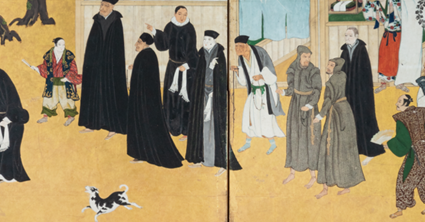
The Nanban byōbu provides valuable visual evidence for distinguishing between different Catholic religious orders active in Japan during the late sixteenth and early seventeenth centuries. In this scene, the missionaries are not represented as a homogeneous group. Differences in clothing, footwear, and appearance allow particular figures to be associated with distinct religious communities, most notably the Society of Jesus and the Franciscan Order.
The figures dressed in long black robes are identifiable as Jesuits. Their characteristic appearance includes black cassocks or cloaks, relatively sober clothing, and, in some cases, European clerical hats or caps. By contrast, the figures represented in simple grey or grey-brown habits, tied at the waist with a cord and shown barefoot, are most plausibly identified as Franciscans. These differences were not merely decorative. Religious clothing functioned as a visible expression of institutional identity and enabled Japanese viewers to distinguish different groups within the Christian missionary community.
The Society of Jesus had been active in Japan since the arrival of Francis Xavier in 1549 and dominated the Catholic mission for much of the second half of the sixteenth century. For several decades, Jesuits effectively enjoyed privileged missionary jurisdiction in Japan and consequently became the Christian missionaries most familiar to Japanese observers. Their black robes became such a recognizable feature of their presence that, in Nanban painting, black clerical clothing could itself function as a visual marker of Christianity.
Jesuit appearance must also be understood within the broader policy of cultural accommodation developed during the mission. Alessandro Valignano, particularly after his inspection of the Japanese mission around 1580, encouraged missionaries to reform their behaviour and presentation in accordance with Japanese expectations of etiquette, hierarchy, and decorum. His prescriptions extended well beyond religious doctrine. They addressed appropriate clothing, modes of social interaction, dining practices, hospitality, architecture, and the organization of reception spaces.
Valignano’s Il Cerimoniale per i Missionari del Giappone made this concern institutional. Jesuit residences were expected to receive visitors according to Japanese conventions, to include appropriately organized reception spaces, and to adopt forms of conduct that would prevent missionaries from appearing culturally inferior or disrespectful in the eyes of Japanese elites. Clothing therefore formed part of a much wider system of social presentation through which the Society of Jesus sought to establish credibility and prestige within Japanese society.
The black-clad missionaries represented in the Nanban byōbu can consequently be understood not only as members of a Christian religious order but also as representatives of a highly organized missionary institution. By the late sixteenth century, the Jesuits had established churches, residences, educational institutions, and networks of Japanese assistants and converts across several regions of the archipelago. Their distinctive garments visually connected individual missionaries to this broader institutional presence.
The figures in grey habits present a markedly different visual identity. Their clothing corresponds closely to the traditional Franciscan ideal of mendicant poverty: coarse grey or grey-brown robes, a cord tied around the waist, simple appearance, and frequently bare feet. The cord and absence of elaborate footwear were particularly effective visual markers of humility and voluntary poverty associated with the followers of Saint Francis. In the context of Nanban painting, such features would have made the friars readily distinguishable from the more sober but socially formal appearance of the Jesuits.
The increasing presence of Franciscans and other mendicant orders from the late sixteenth century transformed the Catholic missionary environment in Japan. During the earlier phase of the mission, the Society of Jesus had operated with effective missionary predominance. From the final decades of the century, however, Franciscans and, subsequently, Dominicans and Augustinians arrived through connections with the Spanish Philippines. Christianity in Japan thus became increasingly institutionally diverse.
This diversification also produced tensions. The Jesuits generally emphasized cultural accommodation, close relationships with daimyō and other elites, and centralized missionary organization. Franciscans, by contrast, tended to place greater emphasis on visible poverty, public preaching, and more direct missionary activity among broader sections of the population. These distinctions should not be treated as absolute, but they contributed to different missionary cultures and became entangled with wider rivalries involving Portuguese and Spanish political and ecclesiastical interests in East Asia.
The simultaneous representation of Jesuits and probable Franciscans in a single composition is therefore historically significant. Their juxtaposition suggests that Japanese observers could recognize Christianity as an internally differentiated religious world rather than as a single homogeneous foreign institution. The painter distinguishes the missionaries through garments, posture, footwear, and appearance in much the same way that Nanban screens differentiate merchants, samurai, servants, and other social groups.
Clothing thus functions as a visual language of institutional identity. The Jesuit black cassock and the Franciscan grey habit communicate not only differences in appearance but distinct religious traditions, ideals, and modes of self-presentation. Within the Nanban byōbu, the contrast between black-clad Jesuits and barefoot, grey-robed friars provides a remarkably concise representation of the growing diversity of Catholic Christianity in early modern Japan.
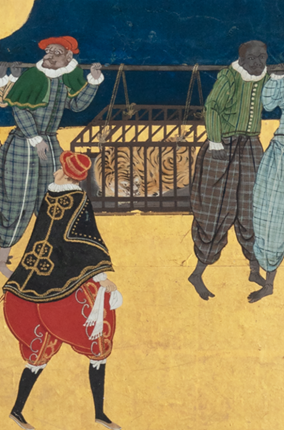
One of the most striking features of the Nanban byōbu is the representation of exotic animals accompanying the Portuguese procession. In this scene, several dark-skinned attendants appear transporting a large animal confined within a wooden cage, apparently intended to represent a tiger. The identification should be treated with some caution, but the animal’s unusual appearance and prominent position within the procession clearly contribute to the representation of the foreign and unfamiliar world associated with the arrival of the Nanbanjin.
Tigers were not native to Japan and were strongly associated with China, Korea, and other lands beyond the Japanese archipelago. The animal would therefore have evoked geographical distance while remaining recognizable within an East Asian cultural context. Its appearance in a Nanban screen combines this existing familiarity with a new visual setting: the animal is incorporated into a Portuguese procession alongside foreign merchants, attendants, imported objects, and other markers of overseas contact.
The broader composition reinforces this interpretation. Nanban paintings repeatedly bring together elements that Japanese viewers could immediately recognize as signs of foreignness: Portuguese merchants in distinctive European clothing, Jesuit missionaries, Africans, large ocean-going vessels, imported commodities, and exotic animals. In this visual vocabulary, the caged animal does not function merely as a zoological curiosity. Rather, it forms part of a larger representation of the extraordinary range of peoples and objects arriving in Japan through Portuguese maritime networks.
These networks extended far beyond a simple connection between Portugal and Japan. Portuguese activity in Asia linked Lisbon with ports and territories across Africa, India, Southeast Asia, China, and Japan, including Goa, Malacca, Macau, and Nagasaki. The people accompanying the Portuguese in the Nanban screens similarly reveal the complexity of this maritime world. Africans appear prominently in several compositions, reflecting the presence of African servants, sailors, soldiers, enslaved people, and other attendants throughout the Portuguese Estado da Índia. Their exact legal or social status cannot be determined from the image alone, but their inclusion demonstrates that the encounter represented in the screens was never simply bilateral, between Japanese and Europeans.
The relationship between the African attendants and the caged animal is therefore particularly significant. Together they create a powerful visual expression of geographical distance and mobility. The procession contains Europeans, Africans, exotic animals, foreign clothing, and imported goods, presenting the Portuguese arrival as the product of a world extending far beyond China and Southeast Asia. Rather than simply recording an individual event, the painter constructs a broader visual narrative of maritime commerce and cross-cultural movement.
The manner in which the animal is represented further strengthens this effect. Confined within a cage and carried through the procession, it becomes an object deliberately made visible. Its position invites the viewer’s attention and contributes to the spectacular character of the Portuguese arrival. Like the distinctive clothing of the merchants, the appearance of African attendants, or the monumental Portuguese ship, the animal functions as a visual marker of difference.
For Japanese viewers of the late sixteenth and early seventeenth centuries, such an animal could therefore signify more than curiosity about the natural world. It suggested distant territories and the remarkable geographical reach of the maritime networks through which the Portuguese reached Japan. Its presence helped construct an image of the Nanbanjin as people connected to a much broader and culturally diverse world.
Within the visual narrative of the Nanban byōbu, the exotic animal thus complements the Portuguese ship. If the kurofune represents the maritime infrastructure that made long-distance movement possible, the caged animal provides a tangible demonstration of what those connections could bring to Japan. Together with Africans, merchants, missionaries, foreign clothing, and imported goods, it transforms the screen into a representation of an interconnected early modern world in which people, commodities, beliefs, information, and living creatures circulated across vast maritime distances.
We shall examine the elements depicted within the building spaces.
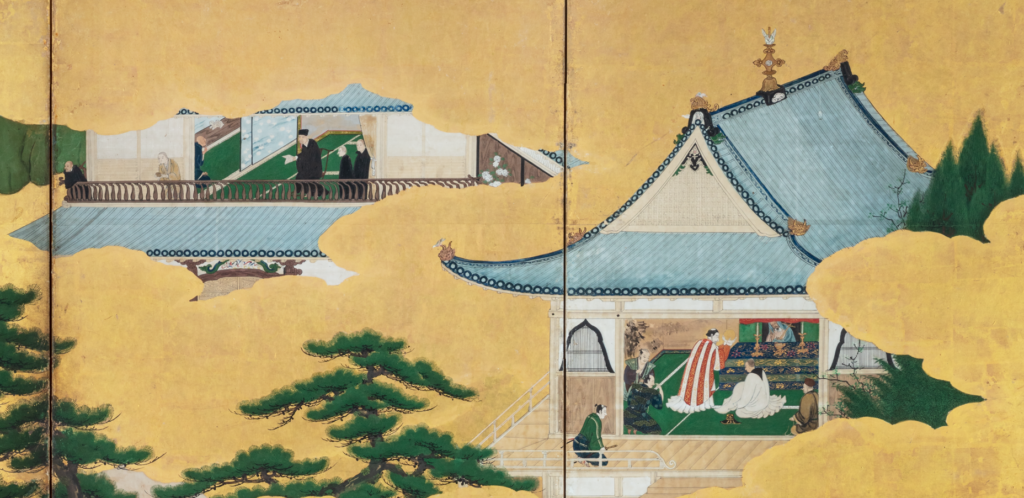
In the right-hand corner, two buildings can be identified. The building on the right, distinguished by a cross at the top and a tall interior space, appears to represent a religious space, possibly a church or chapel. The building on the left, where a priest is depicted seated and teaching, may represent the Jesuit residence.
Based on documentary evidence, however, the division between religious and residential functions was not always as clearly defined as it appears in this representation. For example, the Igreja de Nossa Senhora da Assunção (Church of the Assumption), built under the direction of Organtino Gnecchi-Soldo in Kyoto in 1576, was a three-story building in which different functions were vertically organized: reception spaces were located on the first floor, the chapel on the second floor, and the Jesuit residential quarters on the third floor.
The Nanbanjin Tōrai-zu Byōbu in the collection of the Kobe City Museum, painted by Kanō Naizen, provides a good example of how Nanban art can contribute to a better understanding of these lost Christian buildings when analyzed alongside Jesuit accounts and archaeological evidence.
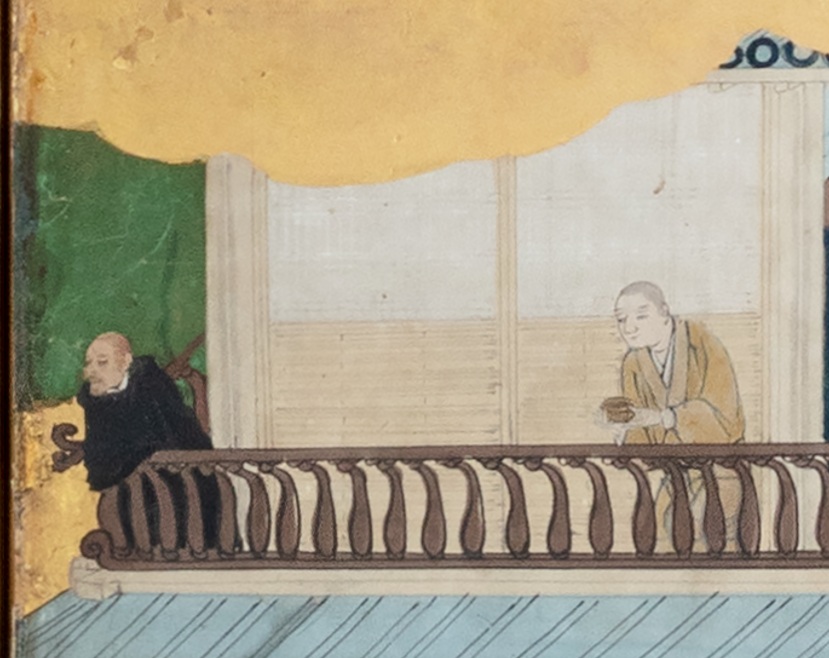
This detail of the Nanban byōbu offers a particularly valuable glimpse into everyday life within the Jesuit mission in Japan. A young Japanese attendant approaches a seated European missionary while carrying a small vessel or bowl, apparently bringing him a drink. Although the image alone does not allow the figure to be identified with certainty, the scene corresponds closely to documentary descriptions of the dōjuku (同宿), Japanese lay assistants who resided within Jesuit establishments and performed important religious, ceremonial, and practical functions.
The dōjuku should not be understood simply as domestic servants. They occupied an important intermediary position between European missionaries and Japanese society. Jesuit sources and later scholarship describe them as catechists, interpreters, secretaries, ritual attendants, hosts, and assistants in the everyday operation of missionary residences. Their knowledge of Japanese language, etiquette, and social conventions made them particularly valuable to missionaries attempting to establish relationships with Japanese elites and to operate effectively within local society.
The institution itself drew upon existing Japanese models. Jesuit use of the term and role appears to have been influenced by Buddhist and elite household traditions in which lay or semi-religious attendants performed ritual and domestic services. Contemporary Jesuit vocabulary similarly refers to dōbō (同朋), shaven attendants serving in the residences of leading lords. The Jesuit mission therefore did not simply import a European category of servant or assistant into Japan; it adapted an existing Japanese social and institutional role to the requirements of the Christian mission.
Hospitality was one of the areas in which these assistants became particularly important. Alessandro Valignano’s regulations for the Japanese mission explicitly required Jesuit residences to appoint a dōjuku, or another suitably qualified person, to take responsibility for chanoyu. The person responsible for tea was expected to maintain the reception space and its utensils, prepare tea, and attend promptly to visitors. When guests arrived, hospitality was to take precedence over other activities so that they would not be kept waiting.
These responsibilities were highly structured. Jesuit regulations required the chanoyu space to be clean and properly arranged, while the assistant responsible for it was expected to maintain the brazier and kettle, prepare the necessary utensils, and ensure that supplies of powdered tea were available. The person charged with these duties was not simply engaged in occasional domestic labour. Tea preparation and guest reception constituted a specialized function within the organization of the residence.
The architectural environment was adapted accordingly. Valignano prescribed that Jesuit residences in Japan should include reception spaces appropriate for receiving Japanese visitors, including a zashiki associated with chanoyu. These secular areas differed from explicitly religious spaces: while churches followed Jesuit architectural requirements, reception rooms were expected to conform more closely to Japanese standards of etiquette and spatial organization. Local knowledge was considered indispensable because inappropriate arrangements could offend visitors and damage the reputation of the Society of Jesus.
The serving of tea was therefore far more than the provision of a beverage. In sixteenth-century Japan, tea formed part of a broader culture of hospitality through which hierarchy, respect, refinement, and social relationships were expressed. Valignano recognized that European missionaries could not receive Japanese visitors effectively according to European conventions alone. Hospitality required personnel who understood when and how guests should be received, how tea should be prepared and presented, and how the associated spaces and utensils should be maintained.
Within this context, the young Japanese attendant represented in the screen acquires particular significance. His action may appear mundane, yet it corresponds closely to a documented system in which Japanese assistants mediated between missionary institutions and local conventions of hospitality. The image therefore provides a possible visual counterpart to the prescriptions preserved in Jesuit texts concerning dōjuku, tea preparation, and the organization of reception spaces.
The role of these assistants extended beyond hospitality. Many dōjuku participated in religious instruction, translation, communication, and the production or transmission of catechetical materials. Some eventually entered the Society more formally as iruman (イルマン, from Portuguese irmão, “brother”). Even those who remained lay assistants were deeply involved in the daily and ceremonial functioning of the mission. Their presence demonstrates that Jesuit establishments in Japan were not exclusively European institutions but collaborative environments whose operation depended substantially upon Japanese personnel and knowledge.
This scene is therefore particularly valuable because it shifts attention away from the monumental imagery often associated with the Nanban encounter—Portuguese ships, spectacular processions, exotic animals, and richly dressed merchants—and toward the ordinary practices through which cultural interaction took place. Christianity in Japan was negotiated not only through preaching, conversion, or diplomacy, but also through everyday acts of communication, hospitality, service, and shared residence.
The figure carrying tea thus offers a small but revealing entry point into the process of Jesuit accommodation. Japanese practices did not remain outside the walls of the mission; they entered its daily routines, reception protocols, personnel structure, and architectural spaces. The dōjuku stood at the centre of this process, helping to translate between cultural systems and allowing the Jesuit residence itself to function within Japanese society.
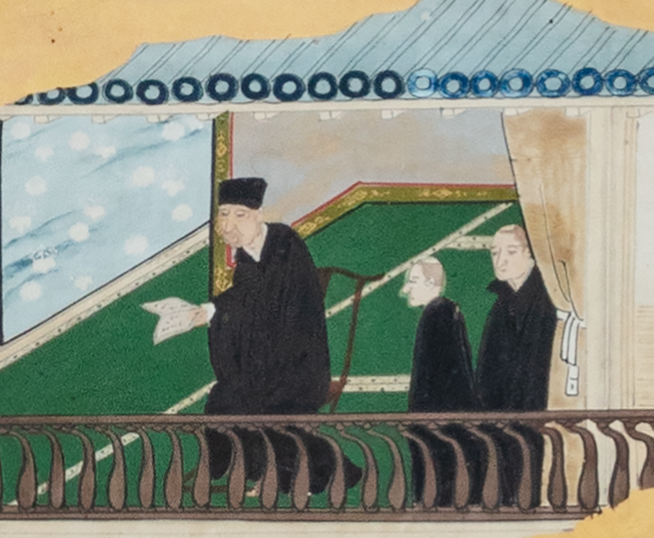
This detail of the Nanban byōbu provides a particularly revealing representation of everyday life within a Jesuit residence in Japan. Three European missionaries dressed in black occupy a Japanese-style interior and appear to be engaged in reading or study. The figure in the foreground holds an open book or document, while the two missionaries behind him seem to participate in the same intellectual activity. The scene draws attention to an aspect of the Jesuit presence that is easily overshadowed by the more spectacular imagery of ships, processions, and foreign merchants: missionary residences were also environments of study, religious formation, writing, and intellectual work.
Such activities formed an important part of Jesuit institutional life. Residences, colleges, and other missionary establishments required spaces in which priests and brothers could read, study, prepare religious instruction, and undertake spiritual exercises. Alessandro Valignano’s regulations concerning Jesuit architecture in Japan explicitly distinguished between areas used for receiving outsiders and more private spaces reserved for the regular occupants of the residence. These inner rooms were to remain protected from unnecessary circulation so that priests and brothers could preserve the peace and quiet required for study and religious practice.
Architecturally, the most significant aspect of the scene is the incorporation of these European intellectual activities into a recognizably Japanese spatial environment. The room appears to be covered with tatami, a fundamental element of Japanese elite and domestic architecture. João Rodrigues observed that Japanese buildings were dimensioned according to the standardized size of the mats with which their floors were covered, producing a modular architectural system in which the arrangement of tatami contributed directly to the proportions of the room.
The use of tatami was not merely decorative. It was closely connected to Japanese practices of bodily comportment, etiquette, cleanliness, and spatial organization. Rodrigues contrasted Japanese floor-based customs with the widespread use of raised chairs and tables elsewhere. In Japanese interiors, where chairs were generally absent, people normally sat directly on the tatami. The flooring therefore structured not only the dimensions of architecture but also the manner in which bodies occupied and moved through interior space.
Jesuit adaptation to such environments formed part of a broader process of accommodation. Under Valignano, missionaries increasingly recognized that successful interaction with Japanese society required attention not only to language and religious teaching but also to architecture, hospitality, etiquette, dining practices, and everyday behaviour. In secular areas of missionary establishments, especially reception spaces, Japanese conventions were deliberately incorporated. Jesuit residences employed zashiki-style rooms with tatami flooring, while visitors were expected to be received according to Japanese standards of decorum.
The adoption of Japanese architectural forms did not, however, necessarily imply a complete transformation of European habits. The figures in the screen appear to retain objects and bodily practices associated with European missionary life, most obviously the books or documents used for study. Some elements of the furnishings may also suggest forms of raised seating, although the precise nature of these objects should be interpreted cautiously. What is clear is that the painter juxtaposes recognizably European missionaries and objects with an interior structured according to Japanese architectural conventions.
This coexistence is particularly important for understanding Jesuit accommodation. The missionary residence was neither simply a European building transplanted into Japan nor a complete imitation of a Japanese household. Rather, it was a negotiated environment in which different architectural, material, and behavioural traditions could coexist. Japanese spatial forms could accommodate European practices of reading, study, religious discipline, and communal life, while European objects and habits were inserted into interiors organized around tatami, zashiki, verandas, and flexible partitions.
The distinction between religious and secular architecture further clarifies this process. Valignano did not advocate the indiscriminate Japanization of Jesuit buildings. Religious spaces were expected to preserve explicitly Christian functions and identities, while secular areas—particularly those related to residence and hospitality—were more readily adapted to Japanese social and architectural conventions. The result was therefore a selective form of accommodation rather than a simple replacement of one architectural tradition by another.
The image also helps illuminate the multifunctional character of Jesuit establishments. These buildings were not only churches. They contained spaces for residence, hospitality, study, religious exercises, instruction, and everyday domestic activity. Valignano’s prescriptions for inner and outer zashiki demonstrate that the internal organization of missionary residences sought to balance two competing requirements: openness toward Japanese visitors and protection of the private intellectual and religious life of the missionary community.
Seen in this context, the apparently quiet scene of missionaries reading inside a tatami-covered room becomes particularly significant. It shows cultural accommodation operating at the level of ordinary daily practice. European missionaries could study Christian texts and conduct the intellectual work of the mission within architectural spaces shaped by Japanese conventions of proportion, flooring, privacy, and circulation.
The combination of books, European religious dress, and Japanese spatial forms therefore provides a concise visual expression of architectural acculturation in the Jesuit mission. Rather than representing either complete Europeanization or complete Japanization, the scene suggests a hybrid environment produced through selective adaptation. The Jesuit residence emerges as a space in which different material cultures, bodily practices, and intellectual traditions were continuously negotiated in the everyday life of early modern Japan.
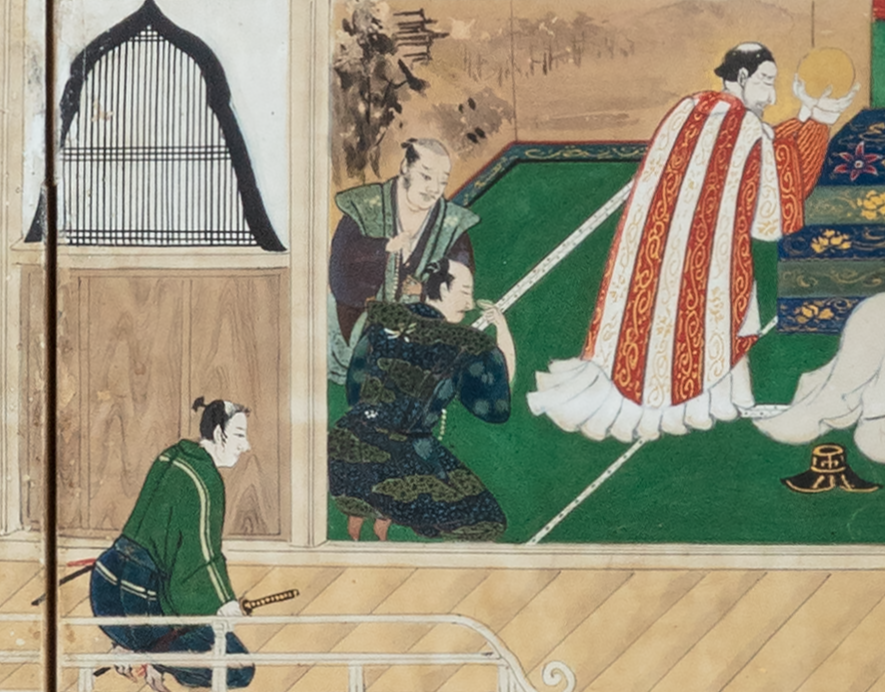
This detail of the Nanban byōbu offers a particularly important representation of Christian worship and the spatial organization of a Jesuit church in early modern Japan. Inside the building, a priest wearing liturgical vestments stands before an altar, while Japanese Christians participate in the ceremony from different positions within and around the interior. In the Kobe screen, the congregation is notably small, and one participant is represented outside the principal room, seated on the veranda. The contrast between those occupying the interior and the figure positioned at its edge makes the organization of space itself an important component of the scene.
The ceremony represented appears to be the celebration of Mass. Other versions of the Nanban screens depict comparable moments in slightly different ways: in the Kobe example, the rite is represented in connection with the distribution of the Host, while another known version shows the priest elevating the chalice. The altar in the Kobe composition is also comparatively detailed, including part of an image of the Salvator Mundi. Such variations demonstrate that painters were not merely depicting a generic Christian interior but were attempting to visualize recognizable elements of Catholic liturgical practice.
At the same time, the spatial distribution of the Japanese participants should be interpreted within the broader context of Japanese social hierarchy. Jesuit missionaries repeatedly observed that relationships in Japan were structured through elaborate conventions of rank, etiquette, precedence, and appropriate spatial positioning. Alessandro Valignano consequently incorporated such distinctions into the regulations governing Jesuit residences and the reception of visitors.
In his Il Cerimoniale per i Missionari del Giappone, Valignano explicitly recognized that spatial proximity within a Jesuit establishment could vary according to the status of the visitor. Depending upon social rank, guests might remain in an outer zashiki while the priests occupied an inner room, share the same zashiki, or remain on the veranda (engawa) while being received from within. Such prescriptions demonstrate that architecture itself participated in the negotiation of hierarchy: access to different zones of the building could communicate distinctions of status without excluding a visitor entirely from interaction.
This documented practice provides an important context for interpreting the church scene in the Nanban byōbu. The figure represented on the veranda should not necessarily be understood as excluded from the Christian ceremony. The engawa functioned in Japanese architecture as a transitional space between interior and exterior, simultaneously a passageway, threshold, and place from which activities inside could remain visible and accessible. João Rodrigues similarly emphasized the importance of verandas in Japanese buildings, where they mediated circulation and social interaction between interior rooms and the spaces surrounding them.
In Jesuit establishments, this architectural element could acquire additional functions. In residences, the veranda served as a zone of reception and transition; in the visual representation of churches, it could also appear as an extension of the space from which Christian practices were observed. Other Nanban screens reinforce this interpretation. Some show individuals praying, making the sign of the cross, or waiting on verandas while religious activity takes place within inner rooms. Such images suggest that participation in Christian life could extend across a spatial continuum rather than being confined to a completely enclosed worship hall.
The placement of participants in the Kobe screen may therefore reflect the interaction between Catholic ritual and Japanese conventions of spatial distinction. It would be too strong to assume that the image records a fixed Jesuit rule assigning particular positions during Mass according to social rank. Nevertheless, the contrast between interior and veranda closely resembles the hierarchical spatial logic explicitly prescribed by Valignano for social interaction within Jesuit establishments.
This distinction is especially important because conversion to Christianity did not erase the existing social structures of Japanese society. Jesuit missionaries had to operate within a world in which rank shaped modes of address, hospitality, bodily posture, access to rooms, and proximity to persons of higher status. Their strategy of accommodation therefore involved negotiating these conventions rather than simply replacing them with European practices.
Architecturally, this produced a distinctive form of Christian space. Valignano insisted that the explicitly liturgical organization of the church should preserve Christian requirements, including the proper orientation and placement of the altar according to the modo nostro, or Jesuit manner. At the same time, other features of the building—including tatami, verandas, sliding partitions, and patterns of access—could draw upon Japanese architectural conventions. The resulting church was therefore neither simply a European structure transplanted to Japan nor an ordinary Japanese residence converted to Christian use.
The Mass scene provides a particularly concise visualization of this negotiation. Catholic worship is organized around the altar and priest, but Japanese architectural forms shape the way participants occupy and perceive the space. The veranda remains visually connected to the interior, permitting participation from a more peripheral position while simultaneously maintaining a clear spatial distinction.
Within the Nanban byōbu, the relationship between altar, interior room, and veranda can therefore be read as evidence of the interaction between Christian ritual and Japanese spatial culture. Rather than demonstrating a simple transfer of European ecclesiastical architecture, the image suggests a process in which liturgical requirements, local architectural forms, and existing conventions of social hierarchy were brought together within the same religious environment. The result was a negotiated Christian space whose organization reflected both the distinctiveness of Catholic worship and the social realities of early modern Japan.
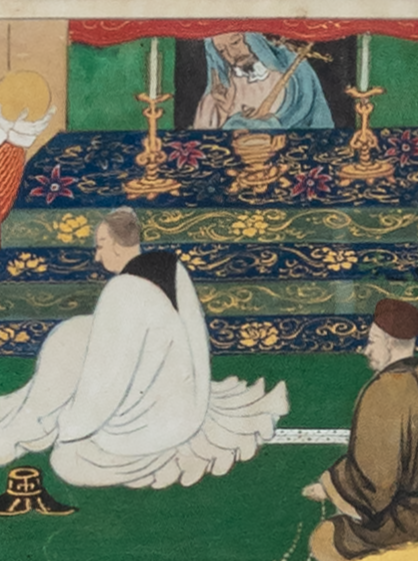
At the centre of the Christian worship space represented in the Nanban byōbu stands the altar, visually distinguished from the surrounding Japanese architectural environment by its rich textiles, candles, liturgical furnishings, and sacred imagery. In the Kobe screen, the altar is particularly clearly articulated and appears beneath a devotional image identifiable as part of a representation of the Salvator Mundi. Together, these elements establish the unmistakably Catholic character of the interior and provide the principal visual focus for the celebration of Mass.
The altar was therefore much more than an item of furniture. It constituted the liturgical and symbolic centre of the church, organizing the orientation of worship around the Eucharistic ceremony. Alessandro Valignano insisted that explicitly religious spaces in Jesuit establishments should preserve the requirements of Catholic worship and follow the modo nostro, or Jesuit manner, even when other parts of the building incorporated Japanese architectural conventions. The altar and its associated imagery were consequently central to maintaining a specifically Christian identity within buildings that could otherwise resemble contemporary Japanese architecture.
This contrast between architectural form and liturgical decoration is particularly significant. Jesuit churches in Japan could employ Japanese timber construction, tatami, verandas, sliding partitions, and other familiar spatial elements, while their interiors were marked as Christian through paintings, sculptures, altarpieces, crosses, candles, vestments, and liturgical furnishings. Contemporary accounts similarly describe Japanese churches whose external architectural appearance remained closely connected to local building traditions while their interiors displayed a markedly different devotional environment.
The material objects necessary for Catholic worship also reveal the extensive geographical networks supporting the Japanese mission. During the sixteenth and early seventeenth centuries, paintings, sculptures, printed devotional images, books, and liturgical ornaments circulated through maritime routes connecting Europe with Goa, Macau, and Japan. In the first decades of the mission, many religious images were imported directly from European centres such as Portugal, Spain, Italy, and Flanders. Engravings were particularly important because they were relatively easy to transport and could subsequently serve as models for the production of new images in Asia.
Christian material culture in Japan, however, should not be understood simply as the eastward transfer of finished European objects. Goa and Macau developed important artistic and institutional environments within the Portuguese and Jesuit networks. Goa contained colleges, workshops, painters, sculptors, and centres of ivory production whose objects circulated throughout Portuguese Asia. Macau became an especially important intermediary for the Japanese mission, combining access to European models with Chinese artisans, Asian materials, and Jesuit institutional networks.
The circulation of religious art therefore involved not only objects but also models, techniques, materials, and artistic knowledge. A European engraving could travel across several maritime centres before being copied or reinterpreted by an artist working in Asia. The distinction between an “European,” “Macanese,” or “Japanese” Christian image is therefore not always straightforward. Many devotional works were products of interconnected artistic networks in which European iconography could be transmitted through Goa or Macau and reproduced using Asian materials and techniques.
Japan itself became an important centre of Christian artistic production. The need to provide churches with paintings and other devotional objects encouraged the establishment of seminaries and workshops in which local students were trained in European pictorial techniques. Particularly important was the activity associated with Giovanni Niccolò, an Italian Jesuit painter who arrived in Japan in 1583. Under Jesuit supervision, painting schools were established in Kyushu and subsequently connected with centres such as Arima and Nagasaki.
Niccolò and other instructors introduced Japanese pupils to techniques including oil and watercolour painting, linear perspective, and chiaroscuro. European engravings and printed images served as important prototypes, while subjects included the Virgin Mary, Christ, saints, and especially representations of the Salvator Mundi. The purpose of these workshops was primarily devotional and missionary rather than the cultivation of individual artistic authorship. Images were copied and reproduced for use in churches, residences, evangelization, and, in some cases, diplomatic exchange.
The Seminário das Artes and related Jesuit workshops therefore transformed the material basis of Christianity in Japan. Japanese students could produce altarpieces, devotional paintings, and other religious objects using imported models while simultaneously working with local pigments, techniques, and decorative conventions. The objects displayed in Japanese churches were consequently not necessarily European imports. They might instead have been produced locally within a Christian artistic environment created through the interaction of European iconography and Japanese craftsmanship.
This context is particularly relevant to the sacred image represented above the altar in the Nanban byōbu. Although its precise origin cannot be established from the painting alone, several possibilities must be considered: it might represent an imported European image, a work transmitted through Macau, or, perhaps more plausibly, a local reproduction based upon a European prototype. The important point is not to assign a single geographical origin but to recognize that such images belonged to a transoceanic Jesuit artistic network connecting Europe, Goa, Macau, and Japan.
The altar itself may therefore be understood as the material result of several overlapping networks. Its Christian iconography originated within European devotional traditions, while the images and objects displayed upon it could have reached Japan through multiple routes or been reproduced locally. Liturgical furnishings and artistic materials similarly circulated across the Portuguese maritime world before being installed within churches constructed by Japanese craftsmen and adapted to local architectural conditions.
This combination produced a religious environment that was neither simply European nor Japanese. The surrounding architecture could employ Japanese techniques and spatial conventions, while the altar asserted a distinctively Catholic liturgical identity. At the same time, even the supposedly “European” elements of the interior might themselves have been produced in Goa, Macau, or Japan by Asian artists working from European prototypes.
Within the Nanban byōbu, the altar thus provides a particularly clear illustration of the material complexity of Christianity in early modern Japan. It demonstrates that the formation of a Catholic sacred space depended not upon the simple transplantation of a European church interior, but upon the circulation, reproduction, adaptation, and recombination of images, objects, materials, and techniques across Europe and Asia. The Christian identity of the church emerged precisely through this interaction between local architecture and a transregional Catholic material culture.
Selected Key Publications
Amaro, Bebio Vieira. 港市長崎におけるキリシタン施設に関する研究 (Kōshi Nagasaki ni okeru Kirishitan shisetsu ni kansuru kenkyū). Doctoral dissertation, Department of Architecture, Graduate School of Engineering, University of Tokyo, 2016.
Arimura, Rie. Iglesias Kirishitan: El arte de lo efímero en las misiones católicas en Japón (1549–1639). Ciudad de México: Universidad Iberoamericana, 2017.
Boxer, Charles R. The Christian Century in Japan, 1549–1650. Manchester: Carcanet, in association with the Calouste Gulbenkian Foundation, the Discoveries Commission, and the Fundação Oriente, 1993.
Cooper, Michael. Rodrigues the Interpreter: An Early Jesuit in Japan and China. New York: Weatherhill, 1973.
Curvelo, Alexandra, and Angelo Cattaneo, eds. Interactions Between Rivals: The Christian Mission and Buddhist Sects in Japan (c. 1549–c. 1647). Berlin: Peter Lang, 2021.
Elison, George. Deus Destroyed: The Image of Christianity in Early Modern Japan. Cambridge, MA: Harvard University Press, 1988.
Oka, Mihoko. The Namban Trade: Merchants and Missionaries in 16th and 17th Century Japan. European Expansion and Indigenous Response, vol. 34. Leiden and Boston: Brill, 2021.
Üçerler, M. Antoni J. The Samurai and the Cross: The Jesuit Enterprise in Early Modern Japan. Oxford: Oxford University Press, 2022.
Vu Thanh, Hélène. Devenir Japonais : La mission jésuite au Japon (1549–1614). Paris: Presses de l’Université Paris-Sorbonne, 2016.
岡本良知『南蛮美術』平凡社、1965年。
岡本良知『南蠻屏風考』昭森社、1955年。
五野井隆史『日本キリシタン史』吉川弘文館、2002年。
高橋勝幸「イエズス会日本コレジョの講義要綱に見るA・ヴァリニャーノの適応主義布教方」『アジア・キリスト教・多元性』第9号、2011年、31–50頁。
坂本満・菅瀬正・成瀬不二雄『南蛮美術と洋風画』小学館、1994年。
坂本満(編著者代表)『南蛮屏風集成』中央公論美術出版、2008年。
松田毅一・川崎桃太(編)『完訳フロイス日本史』中央公論社、2000年。
松田毅一(監訳)『一六・七世紀イエズス会日本報告集』第3期、第1–7巻、同朋舎、1998年。
西村貞『キリシタンと茶道』國書房、1948年。
中西裕樹(編)『高山右近――キリシタン大名への新視点』宮帯出版社、2014年。
スムットニー祐美『茶の湯とイエズス会宣教師――中世の異文化交流』思文閣出版、2016年。
This website was developed as part of the research project “Rethinking Jesuit Architectural Spaces through the Nanban Folding Screens,” by Joanes Rocha. Mentor. Radu Leca.
The project was made possible through the generous support of the Ishibashi Foundation Network Leader Fellowship Programme and was promoted by the Sainsbury Institute for the Study of Japanese Arts and Cultures (SISJAC).
